- Basic
- Symptoms
- Diagnosis
- Treatments
What is Esophageal Cancer?
Esophageal cancer is kind of malignant disease which is formed by paraplasm of any part of tissue cells in esophagus, and is also one of the most common malignant cancers of digestive system, and can easily invade the whole body and spread to other parts in advanced stage.
Esophageal cancer can be divided into four types: the most common one is squamous cell which amounts for over 90% and whose carceration change and metastasis process last long, therefore, early detection can permit many ways like surgery, radiotherapy and chemotherapy to control the condition; other types are very rare, such as adenocarcinoma of esophagus, small cell undifferentiated carcinoma, carcinosarcoma, but have high potential for aggravation.
There are about 300 thousands of people died of esophageal cancer each year, among which incidence of male is significantly higher than that of female with proportion rate being 1.1-17:1; the incidence is increasing as age goes by (especially after reaching 35 years old) and stays the lowest before 35 years old; people among 60-69 years old are in high potential for esophageal cancer, however, people should not be over worried about this, and pay attention to early symptoms in timely manner in life and combine advanced technology to treat it effectively. This brings survival hope for patients.
Causes of Esophageal Cancer
The presence of esophageal cancer combines complicated interaction of mixed factors like living habits, physical condition, inherent gene, microelements, however, the prime culprit may go to long term unhealthy living or diet habit.
Staging of esophageal cancer
Stage 0: early stage esophageal cancer, is also called primary esophageal cancer whose cancer cell is just limited to esophageal cuticular layer with other tissues being normal, and don’t have any malignancy changes or any invasion to other lymph nodes and organs;
Stage I: malignant cells have already invaded into other tissues underneath the cuticular layer and emerged in lamina propia or mucous membrane substratum, but have not invaded into the muscle layer. Cancer cells won’t spread to lymph node or other organ in this stage;
Stage II: cancer cell have invaded into lymph nodes but not into other organs;
Stage III: esophageal cancer has invaded to adjacent tracheas but has not affected to related lymph node; no distant metastasis occur;
Stage IV: esophageal cancer has spread to many organs through blood circulation, like liver, bone, or even head and so on.
What kinds of supports can be obtained?
Practice proves that the clinic team services composed by multiple disciplines like oncosurgery, oncology, pathology, imageology and anesthesia doctors as well as professional nurses, can provide patients with most effective, most suitable and most economic treatment plan, and also can greatly improve the therapeutic effect of treating cancer patients.
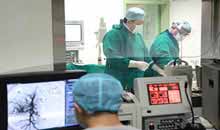
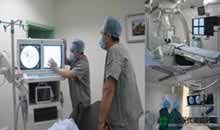
“One station” medical system constructed by Modern Cancer Hospital Guangzhou combining multiple disciplines, can perform comprehensive diagnosis and treatment for patients under the condition of without adding patients’ burden. Therefore, on one hand, it can provide all-round and heartfelt medical services, and on the other hand, it improves medical efficiency and level. There are many channels can be applied to conduct the communication between patients and doctors, like online consultation, email, telephone conversation, and face-to-face consultation. All these consultation services can effectively help patients to fight the cancer. While the medical team faced by the patients includes doctors, nurses, dietitians, interpreters and so on to meet various demands in different level of different countries. Patients would be more confident under the unobstructed communication environment to cooperate the hospital to diagnose and treat the diseases.
Esophageal cancer is a malignant tumor formed by the abnormal proliferation of the esophageal squamous epithelium or glandular epithelium. As one of the common malignant tumors in the digestive system, the incidence of esophageal cancer has been increased year by year. What are the symptoms of esophageal cancer and how to detect esophageal cancer as early as possible?
Early stage esophageal cancer has no obvious symptoms but shows some nerve irritations occasionally. With the development of the disease, the frequency of esophageal cancer symptoms will increase, which including foreign body sensation, difficulty and pain in swallowing. However, since the early symptoms of esophageal cancer are not obvious, it is easy to be overlooked and then leads to delayed treatment.
Five common symptoms of esophageal cancer
Symptom 1: Discomfort or mild pain in the retrosternal region
This symptom does not occur continuously, but happen intermittently and after exertion or fast eating. This is because the esophagus is peristaltic any time, so the symptom occurs only when it creeps to the lesion.
Symptom 2: Foreign body sensation during swallowing
During the swallowing process, it will probably produce foreign body sensation when food, especially hard and dry food, goes through the lesion area. And this sensation usually happens in a fixed site. However, it is easily overlooked because of the characteristic of mild symptoms and intermittent occurrence.
Symptom 3: Slowly swallowing and detained feeling
The symptom mainly manifests a detained feeling when patients are swallowing. It doesn’t occur continuously either, but clear up gradually with the development of the lesion.
Symptom 4: Chest stuffiness and tightness
This symptom is often accompanied by throat dryness. Patients mainly complain of chest stuffiness and tightness, which feels like there are some objects clogging in the chest. It will be more obvious when patients are swallowing, while does not affect their normal life and work.
Symptom 5: Distension and mild pain in the upper abdomen, precordial region and xiphoid process
This symptom is more obvious when patients are ingesting dry and hard food, while it is not occurred every time but intermittently.
Experts from Modern Cancer Hospital Guangzhou remind that if any suspected esophageal cancer symptoms is found, one should go to a regular hospital for examination promptly.
Esophageal cancer refers to malignant tumors in the esophagus, while since early stage patients show no obvious symptoms, it is often easily overlooked. Esophageal cancer mostly manifested as difficulty in swallowing at the beginning, which is often ignored, so the majority of patients have been diagnosed with advanced stage when they visit a doctor. This greatly reduces the treatment effect, so early detection of esophageal cancer is essentially important. Then what are the diagnoses of esophageal cancer?

Diagnoses of Esophageal Cancer
As for esophageal cancer, the most commonly used methods are X-ray barium meal radiography, exfoliative cytology, esophageal endoscopic ultrasonography and fiber endoscopy examination.
1、Fiber endoscopy examination
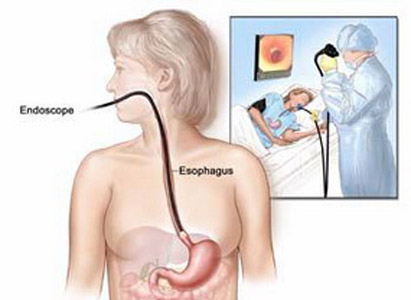
Fiber endoscopy examination has gradually replaced the examination of hard metal pipe mirror nowadays. Because of the distinguishing features of flexibility, good lighting, wide visual range, safety and accuracy, fiber endoscopy examination has become a reliable observation method of upper digestive tract diseases, including esophageal cancer and stomach cancer. Fiber endoscopy is widely used as a clinical routine detection, postoperative follow-ups and clinical treatment effects observation tool. Among early stage esophageal cancer examinations, the detection rate of the fiber endoscope can be up to 85%.
2、Esophageal endoscopic ultrasonography examination
Esophageal endoscopic ultrasonography examination is also gradually applied clinically, the advantage of which is that it can determine the infiltration depth of the lesion within the esophageal wall more accurately. It can also measure the abnormal lymph nodes enlargement outside the wall and distinguish the location of the lesions in the esophageal wall.
3、Esophageal exfoliative cytology examination
Esophageal exfoliative cytology examination is a rather simple method which can reduce the pain of patients and with less false positive rate. Practice has proved that it is feasible to apply esophageal exfoliative cytology examination in esophageal cancer high incidence area and the total positive rate of the examination result is more than 90%. Esophageal cytology examination is the most preferred method of early esophageal cancer diagnosis.
4、X-ray barium meal radiography
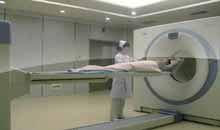
Experienced radiologists will make the patients to swallow the barium substance in several times after fully mixed up. After multidirectional observation of double contrast barium meal radiography carefully, radiologists can discover mucosal depressions or ridges with a diameter of 2mm. But to cancers occur in the spray hilar, sometimes it is easily missed due to the location.
Experts from Modern Cancer Hospital Guangzhou remind that if one is diagnosed with esophageal cancer after related examination, he should go to regular hospitals for treatment promptly.
Even though the living standard is greatly improved, people's body is getting worse and worse, esophageal cancer even seriously threatens to people's health. Due to lack of knowledge on esophageal cancer, people often overlook early symptoms of esophageal cancer and delay early treatment. Then, what are the treatments of esophageal cancer?

Traditional treatments of esophageal cancer
1、Surgery: Surgery is the most common treatment of esophageal cancer, which can be divided into palliative surgery and radical surgery on patients' different condition. Surgery has rather good effects as the treatment of early stage esophageal cancer with localized lesions, but it is not so ideal in the treatment of middle and late staged esophageal cancer with distant metastases. In addition, it is easy to remain residual cancer cells and cause relapse.
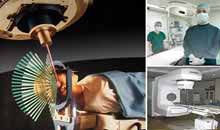
2、Radiation therapy: Radiation therapy is mainly applied for patients who are not suitable for surgery and have no serious difficulties in swallowing. It can be used to reduce the size of tumor before surgery, or eliminate residual cancer cells after surgery.
3、Chemotherapy: Chemotherapy can control the systemic development of esophageal cancer and increase the effect of surgery or radiation therapy if it is undertaken before surgery or radiotherapy, but it will also bring some toxic and side effects.
Innovative treatments of esophageal cancer
1、Traditional Chinese medicine treatment: After years of exploration and research of Chinese medicine, it is confirmed that traditional Chinese medicine treatment has the effect of conditioning yin-yang balance, reinforcing the healthy Qi and anticancer. The advantage of traditional Chinese medicine treatment is that it possesses a certain inhibitory effect on esophageal cancer and the treatment process does not produce side effects. It can also improve the patients' body immune system, reduce the toxicity of chemotherapy drugs, improve the quality of esophageal cancer patients' life and prolong their survival time.
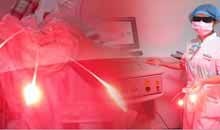
2、Photodynamic therapy: In recent years, the progress of photosensitizer and endoscopic technology has made photodynamic therapy further developed in the treatment of cancer. Photodynamic therapy refers to inserting photosensitizer to the patients intravenously, after which, cancer tissue will absorb the photosensitizer while normal tissues not. By using a special laser irradiation, photosensitizer will make an effect on cancer cells and causing toxic necrosis, and then the tumor will gradually disappear eventually.
Experts from Modern Cancer Hospital Guangzhou remind that: once suffered from esophageal cancer, one should go to a regular hospital for treatment in a timely manner and maintain a good attitude to fight cancer.
If you have any questions, please contact us via online consultation, email or phone call. If you find our website useful, please follow our FaceBook and YouTube, health information will be updated regularly.